Euskera Ikerketa Aldizkaria 2026, 71, 1
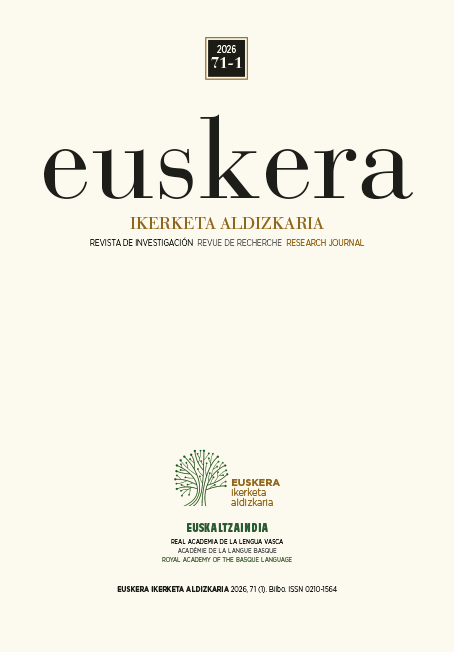
This issue offers readers a varied selection of topics, both in content and in number. The research articles may be divided into two groups. The first includes, firstly, a didactic proposal on how expressive resources can be developed through theatre; secondly, an analysis of the so-called early functional morphemes in the language acquisition of monolingual Basque-speaking children; and, finally, a theoretical framework for defining and understanding the characteristics of the basic skills of academic language. The second group includes two articles located in two neighbouring towns, Goizueta and Leitza, and one about Basque creators and digital print media of the Basque Country. In the former, the use of the familiar feminine allocutive form, or noka, is examined, while in the second the synthetic potential forms of certain verbs are analysed in the local variety of Basque; the latter analyses the presence of Basque creators in selected digital media.
There are four notes. The first commemorates Karmelo Etxenagusia, while the other three address topics in phonetics and phonology: the pronunciation of the Basque spoken in Hernani, an acoustic study of Basque vowels produced in careful and casual speech, and, finally, the phonological evolution of the Basque spoken in Igeldo.
Finally, there are two book reviews. In the first, written in English, the author discusses language, politics and territory; in the second, written in Spanish, readers are given the opportunity to learn about personal names of Indo-European origin in ancient Araba and western Navarre.
Published:
2026-04-30